Plastic Surgeons Are Telling Patients That Breast Mesh Is FDA Approved. It Isn't.
Some plastic and cosmetic surgeons openly advertise that the mesh used in "internal bra" breast surgery is FDA approved. But the U.S. Food and Drug Administration has stated that no surgical mesh is cleared or approved for use in breast surgery.
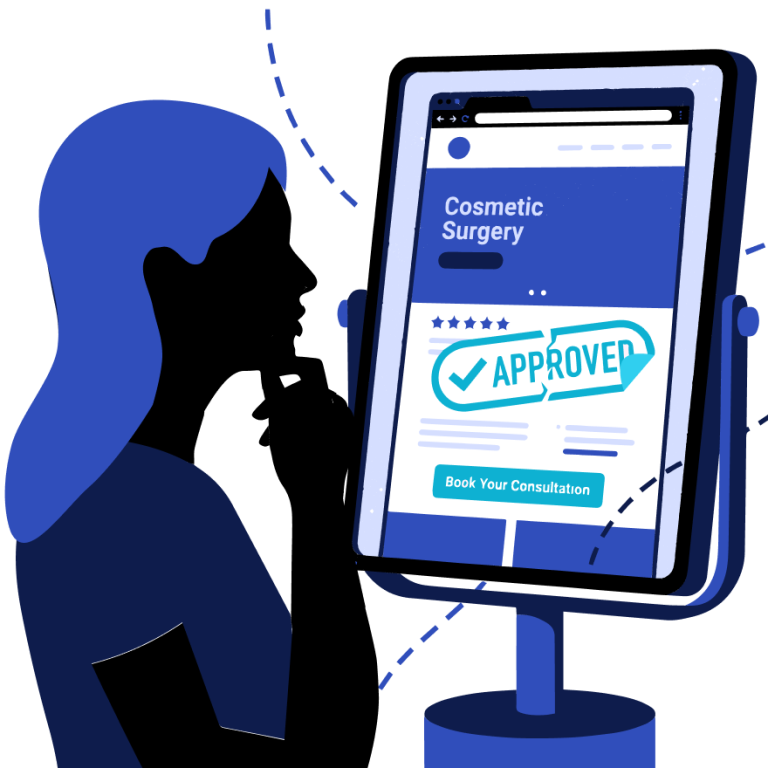


Drugwatch looked at 192 plastic surgery practice websites that advertise breast mesh. Almost 1 in 11 said the mesh was FDA approved or cleared, but did not mention that it has never been cleared for use in the breast. Most other sites did not mention the mesh’s FDA status at all.
These claims appear online as women file lawsuits over breast mesh complications. Here is what Drugwatch found, what FDA clearance really means and what you should ask before surgery.

What Is Breast Mesh, or an "Internal Bra"?
“Breast mesh” is a sheet of material used to support breast tissue or an implant. When used on the lower part of the breast, it is often called an “internal bra.”
Surgeons attach the mesh to the chest wall or to the patient’s own breast tissue. It is used in reconstruction after mastectomy, in augmentation and revision surgeries and in cosmetic breast lifts, where it is promoted as a way to make results last longer.
There are two main types of mesh. Synthetic mesh is man-made. Some types dissolve over several months to about two years. Others, made from polypropylene plastic, stay in the body permanently. Biologic mesh is made from human or animal tissue and is also called acellular dermal matrix, or ADM.

What Drugwatch Found on Surgeon Websites
Seventeen out of 192 practice websites reviewed by Drugwatch (8.9%) said breast mesh was FDA approved or cleared for breast surgery, but did not say that no mesh is actually cleared for the breast. Of the 29 sites that mentioned the mesh’s FDA status, 17 (59%) gave misleading information.
| Plastic Surgeon Breast Mesh FDA Claims | 17 | 8.9% |
| Disclosed off-label use, but called the mesh "FDA approved" | 2 | 1.0% |
| Accurate, or disclosed off-label use | 10 | 5.2% |
| Said nothing about FDA status | 163 | 84.9% |
Only 12 out of 192 sites (6.3%) told patients that using mesh in the breast is considered off-label.
The Southeast stood out: 11 of 50 sites from the region (22%) made a misleading claim, compared to just one or two sites in each of the other four regions. Six of the misleading Southeast sites were in Florida.
Here is how some practices describe breast mesh to prospective patients:
- A Nevada practice: “The GalaFLEX™ mesh is an internal FDA-approved bra mesh to help provide support and stability for a more youthful appearance.”
- A Florida practice: “GalaFLEX mesh is a revolutionary product that’s been approved by the FDA.”
A Georgia practice called GalaFLEX “an FDA-approved technology designed to improve both the quality and longevity of breast lift results.” - A second Florida practice: “Modern breast lift with support mesh uses FDA-approved, bioabsorbable materials specifically designed for aesthetic surgery.”
- A third Florida practice: “DuraSorb is FDA-cleared and approved.”
- A South Carolina practice’s FAQ asks, “Is GalaFLEX FDA approved?” and answers, “Yes.” The page also displays a badge reading “FDA Cleared & Approved Material.”
Some sites used the word “cleared,” but this is also inaccurate, as these products have never been cleared for use in the breast. A North Carolina practice wrote that GalaFLEX and DuraSorb “are both FDA-cleared and widely used in cosmetic and reconstructive breast surgery,” without saying the clearance does not cover the breast.
A few practices gave correct information. One Arizona practice tells patients clearly: “No surgical mesh is FDA cleared or approved specifically for breast surgery.”

FDA Cleared vs. FDA Approved: Why the Words Matter
“Cleared” and “approved” mean different things. They are two separate FDA review processes, and mesh has not gone through either one for use in the breast.
Most moderate-risk medical devices are sold after a process called 510(k) clearance. The company must show the FDA that its device is “substantially equivalent” to one already on the market, meaning it is as safe and effective as that product. If the FDA agrees, the device is “cleared,” not approved.
Higher-risk devices must go through premarket approval, which the FDA calls “the most stringent type of device marketing application.” In this process, the company must provide “sufficient valid scientific evidence to assure that the device is safe and effective for its intended use(s).” Only devices that pass this review are “FDA approved.”
GalaFLEX and Phasix were allowed on the market through 510(k) clearance. The FDA says these products “are cleared for the repair and reinforcement of soft tissue where weakness exists.” This clearance does not include breast surgery.
For patients, this means two things. First, no breast mesh is “FDA approved” because none has gone through premarket approval. Second, even saying “FDA cleared” is misleading on a breast surgery page, because the clearance is only for general soft tissue repair, not for the breast.
Surgeons are allowed to use a cleared device off-label, which means for a use the FDA has not reviewed. The issue is not the off-label use itself. The problem is telling patients, directly or indirectly, that the FDA has approved that use when it has not.
What the FDA Has Said About Mesh in the Breast
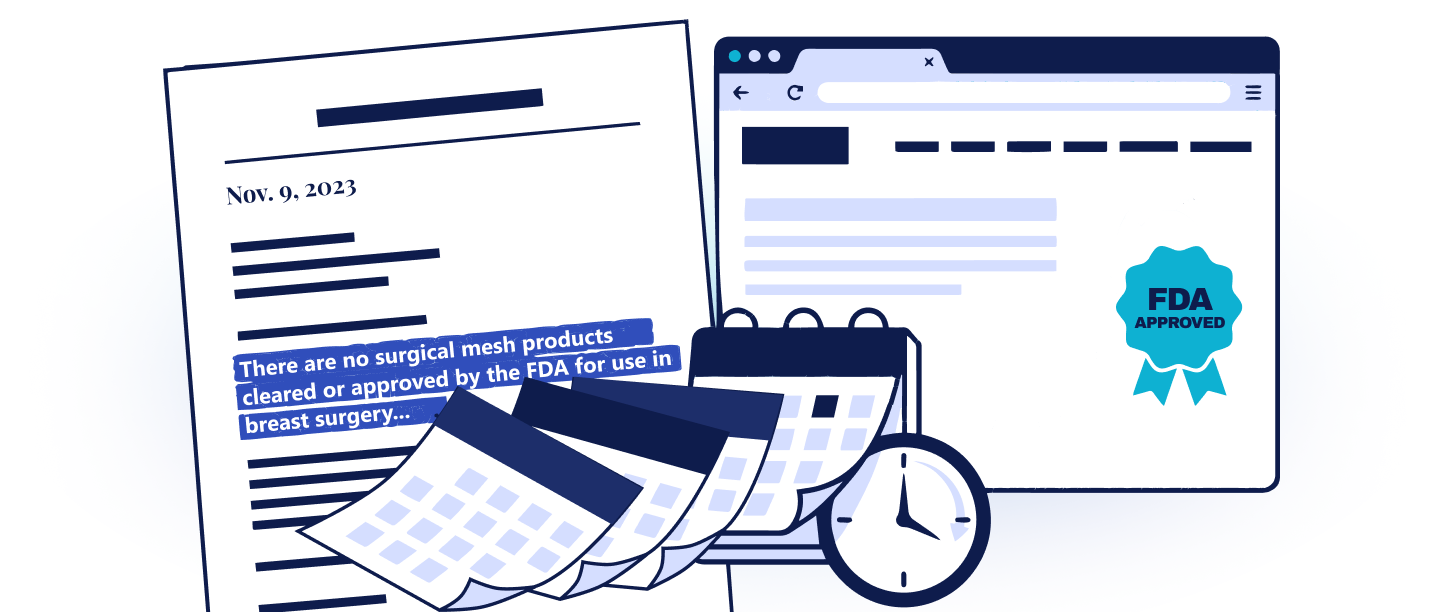
The FDA put its position in writing on Nov. 9, 2023, in a letter to health care providers: “There are no surgical mesh products cleared or approved by the FDA for use in breast surgery, including in augmentation or reconstruction.”
The letter also said that “the safety and effectiveness of surgical mesh in breast surgery, including in augmentation or reconstruction, has not been determined by the FDA.” The agency also noted it was “aware of increased use of surgical mesh products in breast surgery.”
The letter followed Becton Dickinson’s (BD) labeling updates for nine of its mesh products in the GalaFLEX and Phasix lines. The FDA said BD “updated their labeling for these products, including updated warnings and precautions.”
The FDA asked providers to read the updated labeling and to report any problems through MedWatch, the agency’s program for reporting adverse events. The FDA also said it was not recommending removal of mesh in patients who do not have symptoms.
Notably, that letter was almost three years old when Drugwatch reviewed surgeon websites. Seventeen of the sites still described breast mesh as FDA approved or cleared, without saying that the FDA has not cleared it for use in the breast.

What Women Are Experiencing With Mesh
Women who have had problems with breast mesh report complications such as chronic pain or nerve injury, infection or abscess, fluid buildup (seroma), mesh migration, hardened scar tissue around an implant (capsular contracture), tissue death and breast deformity. In some cases, the implant has to be removed.
Breast mesh lawsuits claim that manufacturers promoted mesh for breast surgery, even though the FDA has not cleared it for that use, and did not warn the public about the risk of complications.







A 2024 analysis of published studies on synthetic mesh in implant-based reconstruction after mastectomy found that about 10% of patients had a major complication that required another operation or a hospital stay, and about 3% had their implant removed.
Much less is known about mesh in cosmetic breast lifts and augmentations, which are the procedures most of the reviewed websites were advertising.

Where the Lawsuits Stand, and What Past Mesh Cases Suggest
Breast mesh lawsuits are still in the early stages. There have been no settlements or jury verdicts yet, and there is no class action or multidistrict litigation (MDL). Lawyers are still reviewing cases.
Meanwhile, the use of mesh in breast procedures may be increasing. In September 2026, Anthem began covering GalaFLEX and two other synthetic meshes as “medically necessary when used for breast reconstruction surgery,” joining Cigna as the only two major insurers to cover it. Anthem said the change was due to “additional studies and more data that recently became available.” This coverage is only for reconstruction, not cosmetic surgery.
Other mesh products have faced years of litigation, and some of those cases ended in large verdicts and settlements.
- Transvaginal mesh: In April 2019, a Philadelphia jury awarded $120 million, including $100 million in punitive damages, to a Pennsylvania woman in her case against Johnson & Johnson’s Ethicon unit.
- Hernia mesh, Becton Dickinson: In October 2024, BD, the maker of GalaFLEX and Phasix, agreed to settle more than 38,000 hernia mesh lawsuits in a deal reported to be worth more than $1 billion.
- Hernia mesh, Medtronic: On Aug. 4, 2026, a federal jury awarded $88 million in the first bellwether trial over Covidien’s Symbotex hernia mesh.

Questions to Ask Before Having Breast Surgery With Mesh
- Is this mesh FDA-cleared or approved specifically for breast surgery? (Per the FDA, none are)
- What is this product actually cleared for?
- Why do you recommend mesh in my case, and what results would I expect without it?
- How often do your mesh patients have complications or need another surgery?
- What would removal involve if something goes wrong?
- Will the mesh affect my mammograms or other breast imaging?
Using mesh may still be recommended for some patients. However, that decision should be based on accurate information, not marketing that suggests an FDA endorsement that does not exist.
Calling this number connects you with a Drugwatch.com representative. We will direct you to one of our trusted legal partners for a free case review.
Drugwatch.com's trusted legal partners support the organization's mission to keep people safe from dangerous drugs and medical devices. For more information, visit our partners page.