Something Isn’t Meshing: How the Surgical Implant Industry Keeps Failing Women


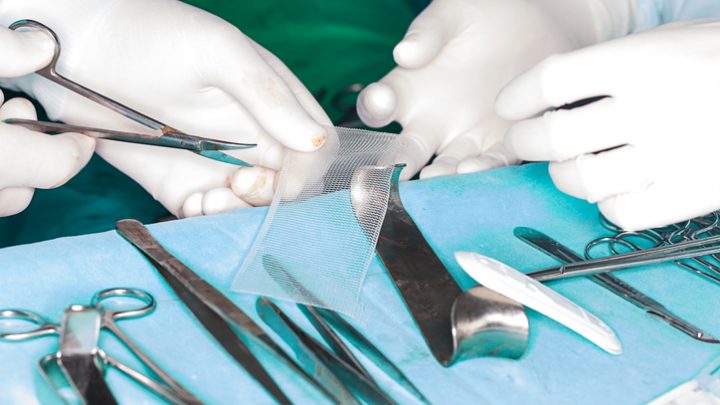
To understand how the medical device industry treats women’s health, start with the story of transvaginal mesh, then look at what’s happening now with breast mesh. The details are different, but the pattern is the same.
Transvaginal mesh is a synthetic, net-like implant, most often made from polypropylene, the same plastic material that’s been used in hernia repairs since the 1950s. It has been used to treat two pelvic floor conditions that affect millions of women: pelvic organ prolapse and stress urinary incontinence (SUI).
Pelvic organ prolapse happens when the muscles and tissues that support the pelvic organs — like the uterus, bladder and rectum — weaken or stretch over time. When that support gives out, those organs can drop and press into or out of the vagina. Women often describe feeling or seeing a bulge, and many live with chronic pressure, discomfort or difficulty using the bathroom. Between 30% and 40% of women experience some degree of prolapse during their lifetime. Childbirth and aging are two of the most common reasons it happens.
Stress urinary incontinence is a related but separate issue. It causes urine to leak when a woman coughs, sneezes, laughs or exercises because the muscles around the bladder and urethra aren’t strong enough to hold it back. SUI affects roughly 1 in 3 women at some point.
For a long time, the go-to surgical fix for pelvic organ prolapse was to use a woman’s own tissue, stitching the prolapsed organ back up to a nearby ligament or muscle. That approach, called native tissue repair, still works well for many women. But it doesn’t hold for everyone. Some women don’t have enough or strong enough tissue to make it last. Starting in the 1970s, surgeons began experimenting with mesh as a reinforcement, inserting it through the abdomen. The mesh was meant to give the tissue something durable to grow into over time, creating a stronger support structure.
Innovation at the Expense of Women’s Health
By the mid-1990s, device companies saw an opportunity. They packaged mesh into kits and marketed them to surgeons as a faster, easier option that could be inserted through the vagina instead of the abdomen, with a shorter recovery time. The FDA cleared the first pelvic mesh device for SUI in 1996 and placed it in the moderate-high risk category (Class II), a classification typically used for devices considered unlikely to cause serious harm.
The problems didn’t take long to surface. Women started reporting chronic pelvic pain, infections, and mesh that was eroding through vaginal tissue. Some experienced organ damage. By 2008, the FDA had received more than 1,000 injury reports and issued its first public health warning. The agency described these complications as “rare,” but they were impacting many patients.
Three years later, the FDA reversed course. A 2011 safety update acknowledged that complications were far more common than initially reported, and the agency expanded its list of known risks to include emotional distress, urinary problems and vaginal shrinkage.
It still took until 2019 for the FDA to order manufacturers to stop selling transvaginal mesh for pelvic organ prolapse repair entirely, after concluding that companies had never adequately demonstrated that the products were safe or effective.
That’s more than two decades from clearance to ban. Two decades of women being implanted with a device the FDA ultimately concluded was never proven safe for the purpose it was being sold for.
Lawsuits Aim to Help Transvaginal Mesh Patients Heal
The lawsuits that followed the ban reflect the extent of the damage. Transvaginal mesh litigation has resulted in roughly $8 billion in settlements, with more than 100,000 women receiving compensation.
And this isn’t history yet. Cases are still being filed and litigated in 2026. Statutes of limitations vary by state, and for many women, the link between their ongoing symptoms and their mesh implant is only now becoming clear. If you had transvaginal mesh surgery, suffered complications, and haven’t spoken to an attorney, it may not be too late.








A Problematic New Use for Mesh
Now, meet the internal bra, a surgical approach that uses mesh inside the breast to support tissue during reconstruction, augmentation or lift procedures.
The name is appealing, and it’s been marketed to both surgeons and patients as an innovative solution. The reality is that no surgical mesh has ever been FDA-approved for use in breast surgery, not for mastectomy reconstruction, not for cosmetic augmentation, not for any breast procedure.
Instead, the mesh products cleared by the FDA for general soft-tissue repair through the 510(k) pathway started being used in breast surgeries. The 510(k) process only requires companies to show that a product is similar to another one already on the market. It doesn’t require proof that the device is safe or effective for any specific use.
The scale of this matters. Around 100,000 breast reconstruction surgeries and 300,000 augmentation surgeries are performed in the United States every year, and mesh is used in a meaningful portion of them. Women who’ve had complications report infections, chronic fluid buildup, mesh migration, tissue death and significant breast distortion. Many have needed multiple follow-up surgeries just to address issues the original procedure caused.
The FDA has flagged concerns. In 2021, the agency warned that certain acellular dermal matrix products, including FlexHD and AlloMax, were associated with higher complication rates than similar devices.
After BD, which acquired C.R. Bard, updated labeling on some mesh products in 2023, the FDA sent a letter to healthcare providers reiterating that these devices aren’t approved for breast surgery. If C.R. Bard sounds familiar, it should. Bard products are part of both the transvaginal mesh lawsuits and the current breast mesh investigations.
A Cycle of Misplaced Trust for Women
Attorneys are now taking cases from women who had breast mesh surgery and developed complications serious enough to require additional procedures. No settlements have been reached yet because this litigation is just getting started. But the legal arguments being made are the same ones that proved successful in the transvaginal mesh cases: the companies failed to warn patients, skipped adequate safety testing and pushed devices into uses they were never cleared for.
While it is unclear whether the breast mesh lawsuits will end up like the transvaginal mesh cases, we should certainly be asking why this is happening again, with the same companies, regulatory problems and the patient outcomes. The 510(k) clearance process was never meant to approve devices for complex surgeries. Women’s bodies should not be used to test products that were never properly studied.
If you’ve had breast mesh surgery and are dealing with complications, talk to your doctor and consider reaching out to a lawyer. If you had transvaginal mesh surgery and haven’t looked into your legal options, you may still have time, depending on your state. Lawsuits are ongoing.
While this story is far from over, one thing is clear: Women deserve better than being the last line of safety testing. They deserve honesty from the companies that make the products implanted in their bodies, and they deserve a regulatory process strong enough to catch problems before they become crises. Until that changes, stories like these won’t stop.